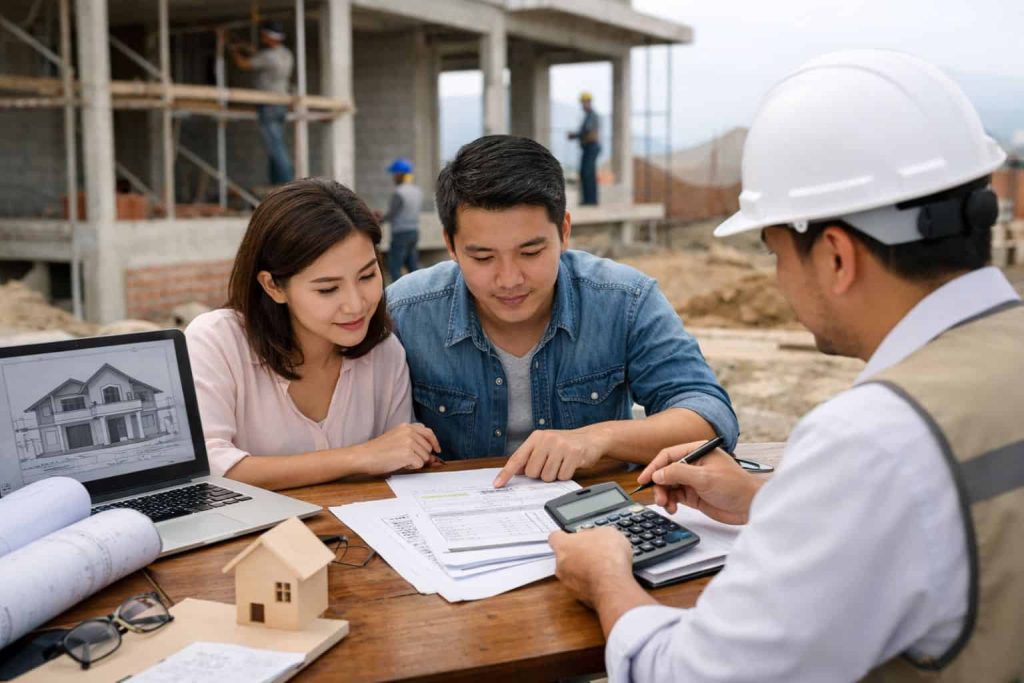
it’s late and I’m writing this after a full day on site so forgive me if this reads a bit more like a conversation than a polished brochure. Because honestly, that’s kind of the point. I keep getting the same question from clients, over and over: “What’s the per sq ft construction cost in Nepal right now?” And every time, I have to explain that it’s not really a single number. It’s a range, and the range depends on a dozen things nobody tells you about until you’re already three lakhs into the project. So I wanted to write this down properly, once, the way I’d actually explain it to a friend building their first house not the way a sales page would. If you’re a homeowner, a landowner, an NRN planning a build back home, or just someone trying to figure out what a realistic budget looks like, this one’s for you.

- What Does Per Sq Ft Construction Cost Mean?
- Average Per Sq Ft Construction Cost in Nepal (2026)
- Factors That Affect Per Sq Ft Construction Cost
- Location
- Soil Condition
- Structural Design
- Number of Floors
- Material Quality
- Labour Cost
- Architectural Complexity
- Finishing Materials
- Site Accessibility
- Municipality Requirements
- Cost Breakdown by Construction Stage
- Construction Cost Comparison: Kathmandu, Lalitpur, Bhaktapur & Beyond
- Hidden Costs Homeowners Often Forget
- How to Reduce Construction Cost Without Compromising Quality
- Why Quantity Surveying (BOQ) Matters
- Why Choose SKR Groups
- Frequently Asked Questions
- What is the average per sq ft construction cost in Nepal in 2026?
- How is per sq ft construction cost calculated?
- How much does labour add to total construction cost in Nepal?
- Why do material prices mess with my budget mid-project?
- What is turnkey construction, and does it cost more?
- Do I actually need a BOQ?
- Does house size affect the per sq ft rate?
- Final Thoughts
What Does Per Sq Ft Construction Cost Mean?
Here’s the thing per sq ft construction cost is just your total construction spend divided by the built-up area of the house. That’s it. That’s the whole definition. But the number means almost nothing on its own, because two contractors can quote you the exact same rate and hand you two completely different houses.
What’s usually included: structural work like foundation, RCC columns, beams and slabs, brickwork, plastering, basic electrical and plumbing rough-in, flooring, doors and windows, and standard painting.
What’s often left out: boundary walls, water tanks, septic systems, furniture, modular kitchens, landscaping, municipality fees, premium fixtures. And this is exactly where I’ve watched budgets quietly fall apart.
Actually, let me rephrase that it’s not that budgets “fall apart.” It’s more that people assume a quoted rate is all-inclusive when it almost never is. I can’t tell you how many times I’ve sat across from a client who was genuinely shocked that boundary walls weren’t in the original number. It’s not that the contractor lied. It’s just that nobody asked, and nobody explained.
Average Per Sq Ft Construction Cost in Nepal (2026)
So here’s a table based on what I’m actually seeing on sites across Kathmandu Valley right now. Treat these as planning ranges, not gospel your real number depends on your design and your site, which is why I always push clients toward a proper BOQ before locking in a budget.
| Construction Category | Approx. Cost Per Sq Ft (NPR) | Typical Structure | Best Suited For |
| Basic Construction | NPR 2,200 – 2,800 | RCC frame, standard rebar, basic finishing | Rental housing, budget-conscious builders |
| Standard Construction | NPR 2,900 – 3,600 | Better rebar detailing, branded fittings, tiled flooring | Most family homes in Kathmandu Valley |
| Premium Construction | NPR 3,700 – 5,000+ | Superior structural design, imported fittings, false ceiling, premium flooring | Custom homes, high-end residences, commercial fronts |
Quick note before you skim past this table. “Basic” doesn’t mean unsafe. It just means simpler finishing on a code-compliant structure. Premium isn’t just fancy tiles either it usually means better structural detailing and tighter supervision too, not just a nicer bathroom.
Factors That Affect Per Sq Ft Construction Cost
No two plots build the same house for the same price. I wish that weren’t true, because it would make my job a lot easier, but it isn’t. Here’s what actually moves the number.
Location
Setting land value aside, location hits your cost through delivery access and local wage rates. A narrow-lane plot in central Kathmandu almost always costs more to build on than an open plot in Lalitpur, simply because trucks can’t get close and materials end up carried by hand.
Soil Condition
This one gets underestimated constantly. Soft or filled soil means deeper foundations or pile work, and that’s cost you’re paying before a single brick goes up. A soil test isn’t expensive. Skipping it can be, though sometimes very expensive.
Structural Design
A simple, symmetrical floor plan is cheaper to build than one full of cantilevers and odd angles. Why? Because complicated geometry needs more steel, more formwork, and more engineering hours, and all of that shows up in your per sq ft rate.
Number of Floors
Going vertical can slightly lower your per sq ft cost on upper floors, since the foundation cost gets spread across more area. But it’s not a simple “more floors, cheaper house” equation taller buildings need stronger foundations from day one, full stop.
Material Quality
Steel brand, cement grade, and brick type are the three biggest swings I see. Using certified steel and cement isn’t optional that’s a safety line, not a budget line. Within that safety baseline though, brand and sourcing still change your final bill quite a bit.
Labour Cost
Skilled mason and rebar wages shift by season and by how many active sites are competing for the same crew in your area. Labour is a bigger chunk of your budget than most people expect, and rushing a timeline usually means paying overtime for it.
Architectural Complexity
Curved walls, double-height living rooms, big glass facades all of it adds material and labour per square foot. Look, a well-designed simple house can look just as striking. It just costs less to build.
Finishing Materials
Honestly, this is where the widest price gap lives. Flooring, counters, fittings you can spend two or three times more here without touching the structure at all. It’s also usually where clients find the easiest room to trim a budget.
Site Accessibility
If a truck can’t reach your plot, materials get shifted onto smaller vehicles or carried in by hand. That labour cost adds up fast. Sites with easy road access are just cheaper to build on, plain and simple.
Municipality Requirements
Setback rules, floor area ratio, height limits, parking requirements these all shape your building’s footprint, and your footprint shapes your cost. Kathmandu Metropolitan City, Lalitpur Metropolitan City, and Bhaktapur Municipality each run their own bylaws, so what flies in one ward might get rejected two wards over.
Cost Breakdown by Construction Stage
I think it helps to actually see where the money goes, stage by stage, instead of just staring at one lump number. So here’s a rough breakdown from a typical residential build.
| Construction Stage | Approx. % of Total Cost | What I’d Tell a Client |
| Foundation & Substructure | 8 – 10% | This is where your soil report either saves you or costs you. I’ve seen both. |
| RCC Structure (Columns, Beams, Slabs) | 22 – 26% | The biggest chunk, hands down. Steel and cement prices move this more than anything else. |
| Brickwork & Blockwork | 10 – 12% | Depends on brick quality and wall thickness you picked at the design stage. |
| Roofing & Waterproofing | 4 – 6% | People skimp here and regret it two monsoons later. Don’t be that person. |
| Plastering | 6 – 8% | Labour-heavy work. The sand-cement ratio matters more than most people realize. |
| Flooring | 8 – 10% | Tile vs. marble vs. granite this swings the number a lot. |
| Electrical Works | 6 – 8% | Budget for the load you’ll need in ten years, not just today. |
| Plumbing & Sanitary | 5 – 7% | Pipe quality and fixture brand are the two big variables. |
| Doors & Windows | 8 – 10% | Timber, UPVC, or aluminium pick based on budget and maintenance appetite. |
| Painting & Finishing | 6 – 8% | Paint quality and number of coats affect cost and how long it actually lasts. |
| Miscellaneous Finishing Works | 4 – 6% | Railings, grills, small touch-ups. Individually cheap, together not so much. |
Notice RCC structure eats up roughly a quarter of your whole budget. That’s why steel and cement price swings hit homeowners so hard mid-project and it’s why I always tell clients to procure structural material in planned batches instead of buying reactively when prices spike.
Construction Cost Comparison: Kathmandu, Lalitpur, Bhaktapur & Beyond
I get asked this a lot: why did my cousin in Bhaktapur pay less per sq ft than I did in Kathmandu for basically the same house? Usually it comes down to a mix of the things below.
| Area | General Cost Trend | Why |
| Kathmandu | Usually higher land scarcity, narrow-road delivery headaches, stricter bylaws | Central wards can run 5–10% above outer areas |
| Lalitpur | Close to Kathmandu in core areas, a bit cheaper further out | Access roads and plot orientation matter more than the ward name |
| Bhaktapur | Generally moderate, but heritage zones can add compliance costs | Older settlement areas sometimes need extra approvals |
| Other Major Cities (Pokhara, Chitwan, Biratnagar) | Often 5–15% lower than the Valley | Cheaper land and labour, but material transport can eat into the savings |
| Rural / Semi-Urban Areas | All over the place, honestly | Road access to the site is the single biggest cost driver |
But don’t assume a cheaper quote in a cheaper area is automatically the better deal. A NPR 2,600 rate with thin rebar spacing isn’t actually cheaper than a NPR 2,900 rate with proper structural detailing it just looks cheaper on paper. Compare the BOQ, not the headline number.
Hidden Costs Homeowners Often Forget
This is where budgets quietly slip. And I mean quietly nobody notices until the total is already 12% over.
- Municipality approval fees permit, naksha pass, and inspection charges vary by ward and plot size.
- Soil testing a small cost upfront that can save you a lot on foundation design.
- Architectural design and drawing fees usually quoted separately from construction.
- BOQ preparation has its own cost, but pays for itself many times over.
- Utility connections electricity meter, water supply, sewerage.
- Boundary walls and gates almost never in the main quote.
- Water tanks overhead or underground storage.
- Contingency budget I tell every client to set aside 8–10% for the unexpected.
- Site preparation leveling, demolition, temporary fencing.
None of these individually breaks a budget. But stack them together and you’re looking at 10–15% on top of your core construction number. Plan for it now. It’s a lot less painful than discovering it in month six.
How to Reduce Construction Cost Without Compromising Quality
Cutting cost and cutting quality are not the same thing. I say this to clients constantly, because confusing the two is exactly how you end up with a cheap house that costs more in repairs five years down the line.
- Proper BOQ preparation before construction starts prevents the over- and under-ordering that quietly inflates costs by 5–10%.
- Material planning and bulk procurement buying steel and cement in planned batches protects you from price spikes mid-project.
- Value engineering simplifying non-structural design elements to cut cost without touching safety.
- Choosing experienced, verifiable contractors the cheapest quote is rarely the cheapest house once rework gets factored in.
- Avoiding design changes mid-construction one layout change can trigger demolition and rework that costs way more than getting it right on paper first.
- Quality supervision catching rebar spacing or curing mistakes while they’re still cheap to fix.
In my experience, the projects that stay closest to budget are never the ones chasing the lowest rate. They’re the ones with a locked-in BOQ and consistent site supervision and the discipline not to change the design halfway through.
Why Quantity Surveying (BOQ) Matters
A Bill of Quantities is a detailed document listing every material, quantity, and labour component your project needs, down to the bag of cement. It’s the difference between an educated guess and an actual engineered estimate.
How it controls cost: it ties every rupee of your budget to a specific, measurable quantity of work, so you know exactly what you’re paying for at each stage instead of trusting a lump-sum promise.
How it prevents material wastage: calculating precise quantities upfront stops the classic problem of over-ordering cement that sits unused, or under-ordering, which stalls work and forces price renegotiation.
How it improves transparency: with a BOQ, you can actually compare contractor quotes side by side, because everyone’s pricing the same scope instead of vague, differently-worded estimates.
This is one of the things our quantity surveying team at SKR Groups does before construction even starts a proper, site-specific BOQ, so clients negotiate from a place of clarity instead of guesswork.
Why Choose SKR Groups
I won’t sit here and tell you we are the cheapest. That’s not how honest cost estimation works, and anyone promising the lowest per sq ft rate in the Valley without even seeing your site is guessing. What I can tell you is how we actually work.
- Engineering-led planning every estimate starts with structural and architectural review, not a generic per sq ft multiplier.
- Detailed cost estimation broken down stage by stage, so you see exactly where the money goes.
- BOQ preparation itemized, so you’re protected from both overpricing and mid-project surprises.
- Construction supervision regular site visits at the stages that actually matter, like rebar placement and curing.
- Material quality control certified materials specified and verified, not left to on-site improvisation.
- Transparent communication honest updates, including when site conditions force a budget adjustment.
- Project management coordinated scheduling so delays don’t quietly inflate your cost.
- Local regulatory knowledge Kathmandu, Lalitpur, and Bhaktapur bylaws, so approvals actually move.
Whether you need us to build turnkey, design the layout first, or just sit with you for an hour and sanity-check a quote you already got, we’re happy to go through your actual numbers.
Frequently Asked Questions
-
What is the average per sq ft construction cost in Nepal in 2026?
For most residential builds in Kathmandu Valley, it lands somewhere between NPR 2,200 and NPR 5,000, depending on whether you’re going basic, standard, or premium. Your exact number depends on design and site conditions, so I’d always push for a site-specific estimate over a general average.
-
How is per sq ft construction cost calculated?
Total estimated cost structure, brickwork, finishing, electrical, plumbing divided by built-up area in square feet. A proper calculation starts from a detailed BOQ, not from working backward off a flat assumed rate.
-
How much does labour add to total construction cost in Nepal?
It’s a significant chunk, though the exact share shifts with project complexity and how much work is mechanized versus manual. Skilled trades like masonry and rebar fitting carry higher rates than general labour.
-
Why do material prices mess with my budget mid-project?
Steel and cement prices in Nepal move with import costs, fuel prices, and demand. Since RCC structure alone is roughly a quarter of your total cost, even a moderate price shift there can meaningfully change your overall budget which is exactly why I recommend a contingency buffer.
-
What is turnkey construction, and does it cost more?
It means the contractor handles everything, foundation to final finishing, and hands you a move-in-ready house. It usually costs more per sq ft because it includes project management and procurement but it tends to cut down on the hidden costs and delays that come with fragmented contracting.
-
Do I actually need a BOQ?
Yes. It’s the single most effective tool for comparing contractor quotes fairly and avoiding cost disputes halfway through construction. I wouldn’t start a project without one, and I wouldn’t recommend you do either.
-
Does house size affect the per sq ft rate?
A bit. Larger homes can sometimes get a slightly lower per sq ft rate because fixed costs like site setup get spread across more area. But it’s a modest effect compared to what material and finishing choices do to the number.
Final Thoughts
Per sq ft construction cost in Nepal was never going to be one clean number, and honestly, I have stopped expecting it to be. It’s shaped by your location, your soil, your design choices, and the materials you pick and understanding what sits behind that number is what actually protects your budget. The homeowners I’ve seen avoid cost overruns aren’t the ones who found the lowest quoted rate. They’re the ones who insisted on a detailed BOQ, planned for the hidden costs early, and worked with engineers who could actually explain where every rupee was going. If you’re planning a build in Kathmandu, Lalitpur, Bhaktapur, or anywhere else in Nepal, get a site-specific estimate before you lock in a budget. We’re happy to walk through your plot, your goals, and your numbers, and put together a transparent BOQ so you know exactly what you’re paying for and why.
Ready to plan your construction budget accurately? Get in touch with SKR Groups for a professional cost estimation and BOQ preparation session tailored to your plot and design.