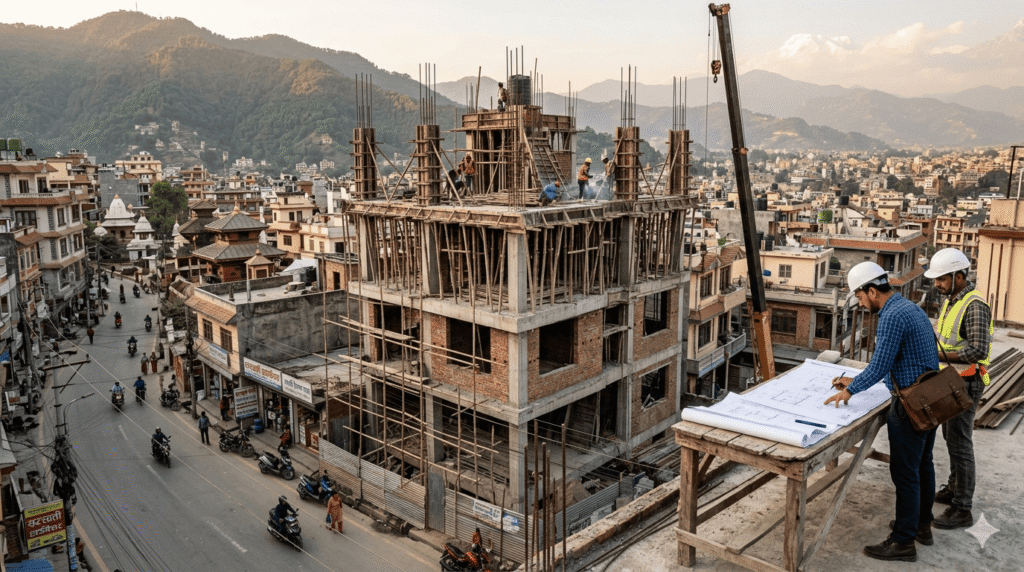
Building a house in Nepal in 2026 costs between NPR 3,000 and NPR 6,000 per square foot, depending on your location, materials, and finish quality. For a basic 1,000 sq ft home, expect to spend around NPR 30–35 Lakh. A mid-range 1,500 sq ft house in Kathmandu will realistically cost NPR 80 Lakh to 1.24 Crore, and premium builds easily cross NPR 1.5 crore. These numbers cover construction only land, permits, compound walls, and utility connections are all on top of this.
- Average Cost to Build a House in Nepal (2026)
- What Is Included in the per square foot construction cost in Nepal
- Factors That Affect House Construction Cost in Nepal
- Location: Kathmandu vs the Rest of Nepal
- Design Complexity
- Construction Type
- Skilled Labor Shortage
- Construction Cost Breakdown: Where Your Budget Actually Goes
- Current Material and Labor Costs in Nepal (2026)
- Cement
- Steel (Sariya / TMT Bars)
- Bricks and Other Key Materials
- Labor Rates
- Pre-Construction Checklist: Documents and Permit Costs
- Real Budget Example: 2.5-Storey House in Kathmandu (1,500 sq ft, Mid-Range)
- Hidden Costs That Catch Most Homebuilders Off Guard
- How to Cut Costs Without Cutting Corners
- Nepali Land Measurement Units: Quick Reference
- Frequently Asked Questions
- What is the cost of a 2.5-floor house in Nepal?
- What is the cost of a 1,000 sq ft house in Nepal?
- What is the minimum budget to build a house in Nepal?
- What is the cost of building a 3-bedroom house in Nepal?
- How much does a small house cost in Nepal?
- Why are houses in Nepal expensive?
- How to make a cheap house in Nepal?
- Plan Your House Construction in Nepal the Right Way
Average Cost to Build a House in Nepal (2026)
The construction cost in Nepal in 2026 breaks down into three clear tiers based on material quality and finishing standard:
| Construction Type | Cost Per Sq Ft (NPR) | What You Get |
| Basic | NPR 3,000 – 3,500 | Standard local materials, simple finishes |
| Mid-Range | NPR 4,000 – 5,500 | Tile flooring, semi-modular kitchen, branded fittings |
| Premium | NPR 6,000+ | Marble, wooden flooring, imported fixtures, custom interiors |
To make this practical, here is what those rates translate to by house size:
| House Size | Basic (NPR) | Mid-Range (NPR) | Premium (NPR) |
| 1,000 sq ft (~3 Aana) | 30 – 35 Lakh | 40 – 55 Lakh | 60 Lakh+ |
| 1,500 sq ft (2.5 Storey) | 45 – 52 Lakh | 60 – 82 Lakh | 90 Lakh+ |
| 2,000 sq ft | 60 – 70 Lakh | 80 Lakh – 1.1 Crore | 1.2 Crore+ |
These figures cover built-up area, your total floor space across all storeys, not the land. Land prices in Nepal sit completely separately, and in prime Kathmandu locations, they can run NPR 1–2 Crore per Aana on their own.
What Is Included in the per square foot construction cost in Nepal
This is where most people get caught out. When a contractor quotes a per sq ft rate, it typically covers:
- Foundation, columns, beams, and RCC slabs
- Brick masonry and external/internal plastering
- Basic doors, windows, and flooring
- Standard electrical and plumbing rough-in work
What is commonly left out of that headline number:
- Compound walls, gates, and boundary fencing
- Overhead water tank and underground sump
- Exterior driveway and parking area
- Interior furniture and furnishings
- Permits, soil testing, and documentation fees
- Landscaping and exterior finishing
A contractor offering NPR 2,500 per sq ft may look attractive until you realise plastering and electrical work are excluded. Always request an itemised BOQ (Bill of Quantities), never compare quotes that are not structured identically.
Factors That Affect House Construction Cost in Nepal
The cost to build a house in Nepal varies widely, and these key factors are what actually drive your final budget up or down.
Location: Kathmandu vs the Rest of Nepal
Urban areas like Kathmandu consistently push construction costs higher, skilled masons cost more, material delivery is pricier in congested zones, and permit fees are steeper. Here is a city-wise comparison for mid-range construction:
| Location | Approximate Cost Per Sq Ft (NPR) |
| Kathmandu Valley | 4,200 – 5,500 |
| Pokhara | 3,500 – 4,800 |
| Biratnagar / Birgunj | 3,200 – 4,400 |
| Hetauda / Butwal | 3,000 – 4,200 |
| Rural / Hilly Areas | 2,800 – 4,500 |
Building outside Kathmandu saves on labor, but if your site is far from a major road, material transport costs can add 15–30% on top, so the savings are not always as large as they look on paper.
Design Complexity
A basic rectangular or square layout is the cheapest structure you can build. The moment you add irregular shapes, multiple cantilevered balconies, basement floors, or a complex roofline, the per sq ft cost climbs. Unique design features can add NPR 200–500 per sq ft to your total bill without adding functional living space.
Construction Type
RCC (Reinforced Cement Concrete) framing is the standard across Nepal and the strongest option for seismic zones. Prefab construction costs NPR 1,800–3,500 per sq ft and builds faster, but offers fewer design options. Wooden houses run NPR 2,500–4,500 per sq ft and look beautiful, but require ongoing maintenance.
Not sure which construction type suits your plot and budget? Talk to a construction specialist in Nepal before committing to a structural approach.”
Skilled Labor Shortage
Nepal’s construction sector has been dealing with a genuine shortage of skilled masons and tradespeople, driven largely by migration to the Gulf and Malaysia. This has pushed daily wages up steadily year over year, particularly inside the Kathmandu Valley.
Construction Cost Breakdown: Where Your Budget Actually Goes
Understanding this split helps you decide where to invest and where you can reasonably cut back:
| Construction Phase | % of Total Budget | What It Includes |
| Foundation & RCC Structure | 35 – 40% | Excavation, footing, columns, beams, slabs |
| Brick Masonry & Plastering | 15 – 18% | All walls, internal and external plaster |
| Flooring | 8 – 12% | Tiles, marble, or parquet throughout |
| Doors & Windows | 6 – 8% | Frames, shutters, glazing, hardware |
| Electrical Work | 5 – 7% | Wiring, MCB panels, switchboards, fittings |
| Plumbing & Sanitation | 5 – 7% | Water lines, drainage, bathroom fixtures |
| Painting | 4 – 6% | Interior and exterior complete paint system |
| Kitchen & Fittings | 3 – 5% | Cabinets, countertops, faucets, and sanitaryware |
| Staircase & Railing | 3 – 4% | Steps, balustrade, and railing system |
| Contingency | 5 – 8% | Price changes, design adjustments, rework |
The structural phase, foundation, columns, and slabs, is the one place where cutting corners has long-term consequences. In a seismically active country like Nepal, weak RCC work is not a budget decision; it is a safety risk. You can upgrade floor tiles five years from now. You cannot re-engineer a column once the building is standing.
Finishing costs, on the other hand, are where many home builders get surprised late in the process. Flooring upgrades, a modular kitchen, branded sanitaryware, and quality paint can together account for 30–40% of your total spend once you add it all up.
Current Material and Labor Costs in Nepal (2026)
Materials and labor together make up roughly 85–90% of your total construction bill, so getting these numbers right before you budget is non-negotiable.
Cement
| Brand / Type | Price Per 50 kg Bag (NPR) | Best Use |
| OPC — Shivam, Hongshi | 780 – 950 | Columns, beams, foundations |
| PPC — Arghakhanchi, Hongshi | 630 – 780 | Plastering, brickwork, infill walls |
| CG OPC / Hetauda OPC | 850 – 1,100 | Heavy structural work |
Use OPC Grade 43 or 53 for all structural elements. PPC is a cost-effective option for non-structural work and plastering — you can save NPR 100–200 per bag compared to OPC without any quality trade-off in those applications.
Steel (Sariya / TMT Bars)
TMT (Thermo-Mechanically Treated) bars are the correct choice for all RCC construction in Nepal’s seismic zone. Fe500D grade is now the recommended standard under updated Nepal Building Code guidelines.
Based on current live ex-factory rates from major manufacturers in March 2026:
| Brand Tier | Ex-Factory Price (NPR/kg) | Retail Price in Kathmandu (NPR/kg) |
| Premium — Himal, Panchakanya | 91 – 96 | 105 – 120 |
| Mid-Range — Jagadamba, Ambe TMT | 85 – 92 | 95 – 108 |
| Standard — Saakha, local brands | 76 – 85 | 88 – 100 |
Important VAT and transport: All ex-factory prices exclude Nepal’s 13% VAT and transportation charges. By the time steel reaches your site in Kathmandu, retail prices typically run 15–20% above ex-factory rates. Always ask suppliers whether the quoted price is ex-factory or delivered-to-site, and confirm whether VAT is included; the difference can add NPR 10–18 per kg to your actual cost.
Plan your steel purchase early. Prices climb further heading into the post-monsoon construction rush (October–November), and locking in your order before that window can meaningfully protect your budget.
Bricks and Other Key Materials
| Material | Current Price (2026) |
| Standard red bricks | NPR 16 – 25 per piece |
| Machine-made / Chinese bricks | NPR 22 – 28 per piece |
| AAC blocks (lightweight) | NPR 50 – 90 per block |
| River sand | NPR 4,000 – 5,500 per cubic meter |
| Stone aggregate | NPR 28,000 – 38,000 per tipper |
| Basic floor tiles | NPR 80 – 200 per sq ft |
| Marble flooring | NPR 300 – 1,500 per sq ft |
Labor Rates
| Worker Type | Kathmandu (Per Day) | Outside Kathmandu |
| Skilled Mason (Mistri) | NPR 1,200 – 1,800 | NPR 900 – 1,400 |
| Semi-Skilled Helper | NPR 800 – 1,200 | NPR 600 – 950 |
| Unskilled Labor | NPR 600 – 900 | NPR 500 – 750 |
| Electrician | NPR 1,400 – 2,000 | NPR 1,000 – 1,600 |
| Plumber | NPR 1,200 – 1,800 | NPR 900 – 1,400 |
Note on specialist finishing tradespeople: standard mason rates above apply to general RCC and masonry work. Specialist finishing workers, tilers, marble setters, and decorative plaster workers typically charge NPR 1,800–2,200 per day in Kathmandu due to the higher skill level and lower availability of these trades.
Architect fees run 2–5% of total construction cost, or NPR 50,000–2,00,000 for a complete set of architectural and structural drawings on a typical residential project.
Pre-Construction Checklist: Documents and Permit Costs
Getting your paperwork in order before construction starts is not just a legal requirement; it is the single best way to avoid costly delays once work begins. If navigating Naksha Pass applications feels overwhelming, get expert help from a professional construction team in Nepal before you begin.
Documents you need before breaking ground:
- Lal Purja: Verify land ownership is clean and dispute-free
- Naksha Pass / Nirmaan Swikriti: Official building permit from your Nagarpalika or Gaunpalika
- Structural Drawings: Must be prepared and stamped by a licensed engineer
- Soil Test Report: Essential for correct foundation design
- Contractor Agreement: Written contract covering materials, timeline, and payment stages
| Permit / Document | Estimated Cost (NPR) |
| Naksha Pass — Kathmandu Metro | 20,000 – 80,000+ |
| Naksha Pass — Other Municipality | 10,000 – 40,000 |
| Naksha Pass — Rural Municipality | 3,000 – 15,000 |
| Soil Test Report | 15,000 – 40,000 |
| Architectural + Structural Drawings | 30,000 – 1,50,000 |
Real Budget Example: 2.5-Storey House in Kathmandu (1,500 sq ft, Mid-Range)
The 2.5-storey house is Nepal’s most popular residential construction type. A standard mid-range build of around 1,500 sq ft in Kathmandu typically looks like this:
| Cost Component | Estimated Budget (NPR) |
| Foundation + RCC Structure | 28 – 40 Lakh |
| Masonry + Plastering | 5 – 7 Lakh |
| Flooring (Tiles / Marble) | 8 – 15 Lakh |
| Doors + Windows | 6 – 12 Lakh |
| Electrical Work | 4 – 7 Lakh |
| Plumbing + Sanitation | 4 – 8 Lakh |
| Painting | 3 – 6 Lakh |
| Kitchen + Fixtures | 4 – 10 Lakh |
| Staircase + Railing | 3 – 8 Lakh |
| Contingency (10%) | 7 – 11 Lakh |
| Total | 72 Lakh – 1.24 Crore |
For builds outside Kathmandu Valley, subtract 15–20% from these figures. For premium finishes with imported materials, the total can comfortably cross NPR 1.5 Crore for this same size.
Note on the lower bound: The NPR 72 Lakh figure assumes tight cost management, careful material sourcing, and a self-managed procurement process. With updated 2026 steel and labor prices, NPR 80–85 Lakh is the more realistic starting point for most mid-range builds in central Kathmandu. The lower figure is still achievable but increasingly requires deliberate planning to hit.
Hidden Costs That Catch Most Homebuilders Off Guard

Even a well-prepared BOQ will not cover everything. These are the costs that routinely surprise first-time builders:
- Compound wall and gate: NPR 3–15 Lakh, depending on perimeter length
- NEA electricity and KUKL water connection: NPR 50,000 – 2,00,000
- Overhead tank and underground sump: NPR 50,000 – 2,00,000
- Driveway and parking area: NPR 1–3 Lakh
- Inverter or backup power: NPR 1–4 Lakh
- Furniture and interior furnishings: Often an additional 15–25% of the construction total
Material prices in Nepal also spike during the Dashain-Tihar festival period and at the start of the post-monsoon construction season, typically October, when demand surges across the country. Buying your cement, steel, and bricks a few weeks before the rush can save 8–15% on materials alone.
Always hold back a contingency fund of 10–15% of your total estimated construction budget. This is not padding; it reflects the real-world variability of material prices, design tweaks, and site conditions that affect virtually every construction project in Nepal.
How to Cut Costs Without Cutting Corners
Reducing your construction budget does not mean buying cheaper materials or skipping steps; it means planning smarter before the first brick is laid. These seven habits consistently save money on residential builds across Nepal without touching structural quality or safety.
- Keep the floor plan simple; a rectangular or square layout costs 10–20% less to build than irregular shapes
- Buy materials in bulk before monsoon, pre-monsoon purchasing (February–April) typically locks in lower prices
- Start post-monsoon, October to February, gives the best curing conditions for concrete and avoids weather-related delays and rework
- Use PPC cement for non-structural work, identical performance to OPC for plastering and brickwork at a lower price
- Lock your design before starting; mid-construction design changes are the leading cause of budget overruns on residential projects in Nepal
- Get three itemised quotes, only compare quotes that are broken down identically by BOQ line item
- Source materials locally, locally produced cement, clay bricks, and river sand cut transport costs significantly compared to imported alternatives
Nepali Land Measurement Units: Quick Reference
| Unit | Square Feet | Square Meters | Where It Is Used |
| 1 Aana | 342.25 sq ft | 31.80 sq m | Kathmandu Valley, hilly urban areas |
| 1 Ropani | 5,476 sq ft | 508.74 sq m | Kathmandu Valley, hilly regions |
| 1 Dhur | 182.25 sq ft | 16.93 sq m | Terai region |
| 1 Kattha | 3,645 sq ft | 338.63 sq m | Terai region |
Most residential plots in urban Kathmandu sit between 3 and 5 Aana. Building vertically, 2.5 or 3 storeys, is the practical way to maximise living space on those smaller plots. Square meter figures are increasingly used in official government documents, municipal permit applications, and engineering drawings, so it helps to have both measurements on hand.
Frequently Asked Questions
Here are the most commonly asked questions regarding house construction costs in Nepal:
What is the cost of a 2.5-floor house in Nepal?
A 2.5-storey house of around 1,500 sq ft in Kathmandu costs NPR 80 Lakh to 1.24 Crore at mid-range quality. Basic builds start from NPR 45 Lakh, and premium finishes can push the total well above NPR 1.5 Crore.
What is the cost of a 1,000 sq ft house in Nepal?
A 1,000 sq ft house costs NPR 30–35 Lakh for basic, NPR 40–55 Lakh for mid-range, and NPR 60 Lakh+ for premium construction. Kathmandu buildings generally run 15–20% higher than buildings elsewhere in Nepal.
What is the minimum budget to build a house in Nepal?
The bare minimum to build a house in Nepal is around NPR 25–30 Lakh for a simple single-storey on a rural plot with basic local materials. In Kathmandu, even a small 2-bedroom home of basic quality needs at least NPR 35–40 Lakh.
What is the cost of building a 3-bedroom house in Nepal?
A 3-bedroom house typically covers 1,200–1,500 sq ft, putting the construction cost between NPR 42 Lakh and NPR 82 Lakh, depending on location and finish. Kathmandu and Pokhara sit at the higher end of that range.
How much does a small house cost in Nepal?
A small 600–800 sq ft single-floor house costs NPR 18–28 Lakh in rural or semi-urban areas at basic quality. The same size in Kathmandu at mid-range standard runs NPR 28–42 Lakh due to higher labor and transport costs.
Why are houses in Nepal expensive?
The main drivers are rising land prices in Kathmandu, increasing material costs, a shortage of skilled labor due to foreign migration, and mandatory seismic-resistant construction under the Nepal Building Code. Material inflation alone is running 7–10% year-on-year in 2026.
How to make a cheap house in Nepal?
Stick to a simple rectangular layout, use locally sourced materials, and buy cement and steel before the Dashain price spike. Starting construction post-monsoon and using PPC cement for non-structural work also cuts costs without touching structural quality.
Plan Your House Construction in Nepal the Right Way
Building your dream house in Nepal in 2026 is fully achievable, but only if you walk into it with accurate numbers and a realistic plan. Construction costs have risen 7–10% over the past two years, material prices are still moving, and the skilled labor market remains tight. None of that changes the fact that thousands of families complete their homes every year.
The decisions that matter most happen before construction starts: verifying your Lal Purja, securing your Naksha Pass, hiring a licensed structural engineer, getting a proper BOQ, and locking your design before excavation begins. Get those foundations right, literally and figuratively, and your construction journey becomes far more manageable from start to finish.
Additional Resources:
Department of Urban Development and Building Construction (DUDBC)